Most platforms give you a detection library and call it done. Orden Cyber gives you a knowledge fabric: a living intelligence layer your SOC team builds, extends, and owns. Every pipeline your analysts create, every constraint they give during wargaming, every prediction that fires draws on that accumulated context.
A platform that deepens with use requires AI and human judgment to be designed together, not AI bolted onto a detection engine with human approval bolted onto that. Orden Cyber was built from the ground up on agentic pipeline infrastructure where analyst-built detection logic, operator wargaming constraints, and predictive modeling all operate in a single unified runtime. The knowledge your team encodes today shapes every response decision tomorrow.
Start with pre-built detection models from leading vendors, layer your analysts' expertise on top, or build entirely from scratch. Whatever path you take, the result is a permanent organizational asset, not a vendor dependency.
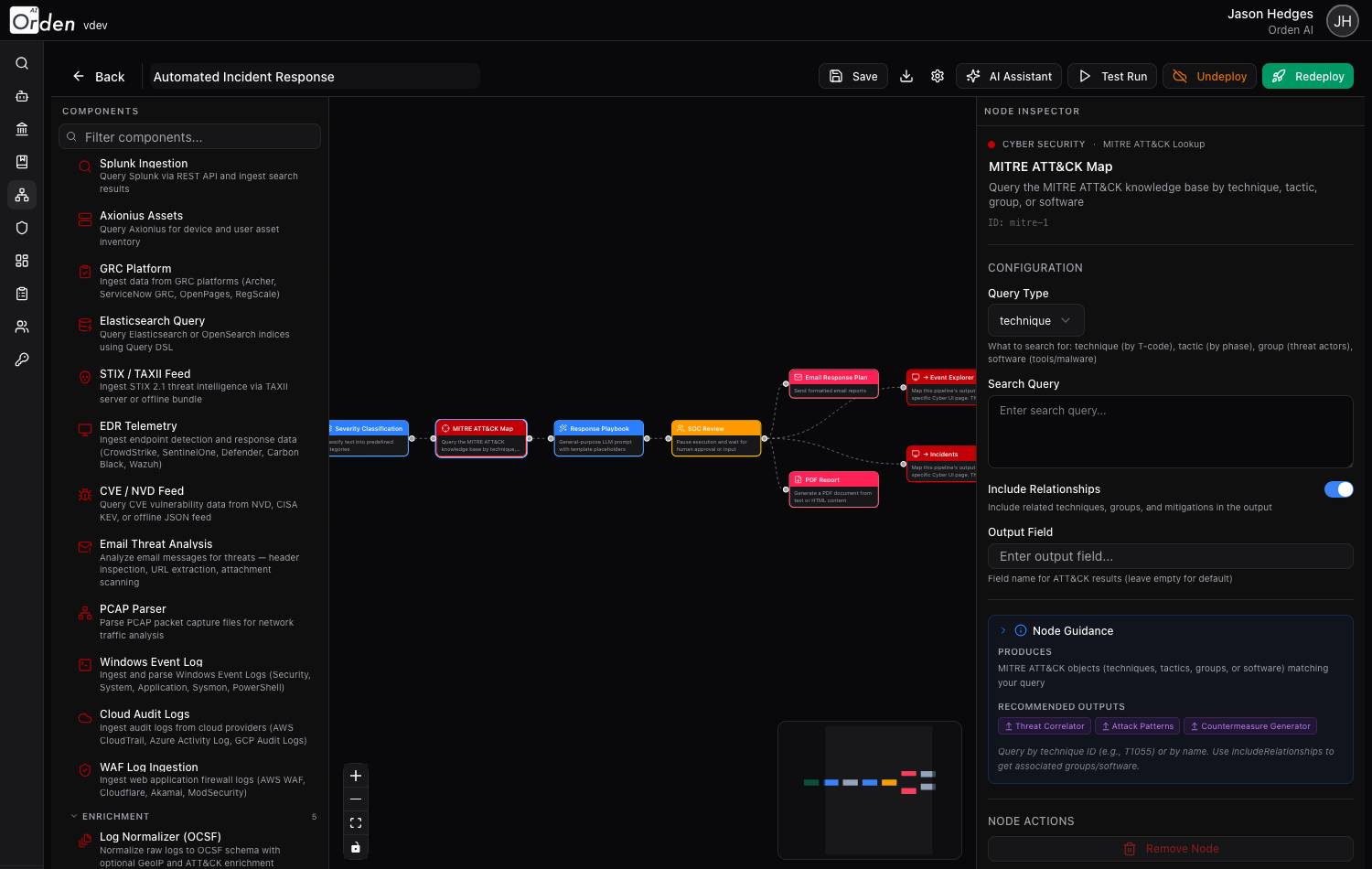
Analysts describe a detection goal in plain language and receive a working pipeline draft. Every pipeline they build (detection logic, countermeasure wiring, approval checkpoints) becomes a versioned, portable organizational asset that deepens with use.
Analysts describe what they want to detect and how to respond. Orden Cyber drafts a working pipeline they can refine, version, and share.
Pipelines, detections, countermeasures, and approval workflows are all first-class artifacts. Move them across environments and classification boundaries.
The skilled analyst becomes the detection author. The knowledge your SOC builds stays with the SOC.
Every competitor ships a detection library they maintain. Your analysts are consumers of someone else's model of your threat environment.
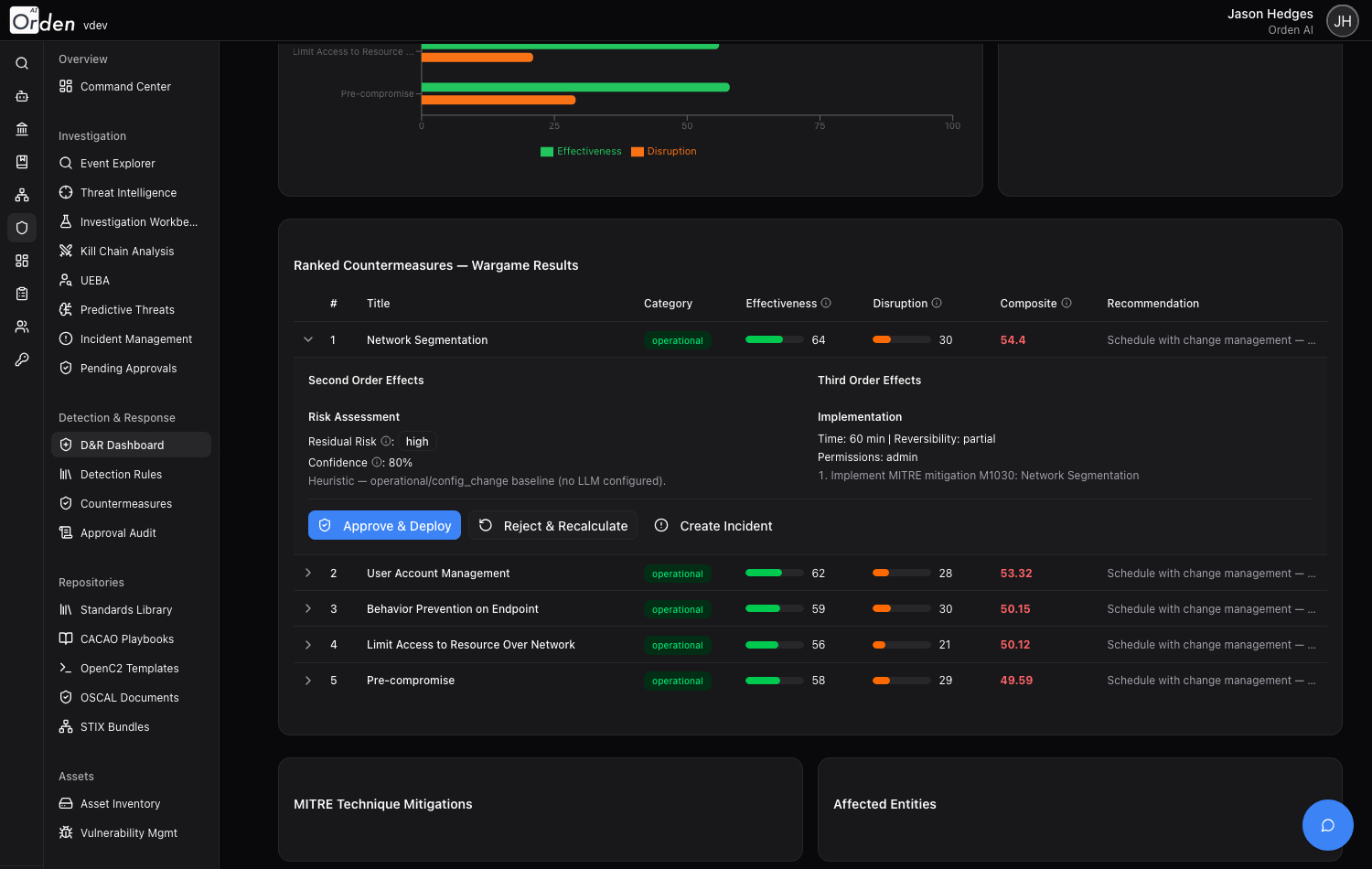
Orden Cyber generates ranked countermeasures, simulates 2nd- and 3rd-order operational effects, and presents the top three. The operator rejects in natural language (for example, "avoid blocking that subnet, it's production"), and the AI regenerates with those constraints incorporated.
Each option is scored with downstream operational impact, not just primary effect on the threat.
"Don't touch production." "Skip the IdP step until 0600." Constraints are absorbed by the AI and reflected in the regenerated options.
Not a pre-authored playbook. The response fits the situation, not the template.
Every other SOAR platform executes a pre-authored playbook. None simulate downstream effects or accept natural-language constraints mid-decision.
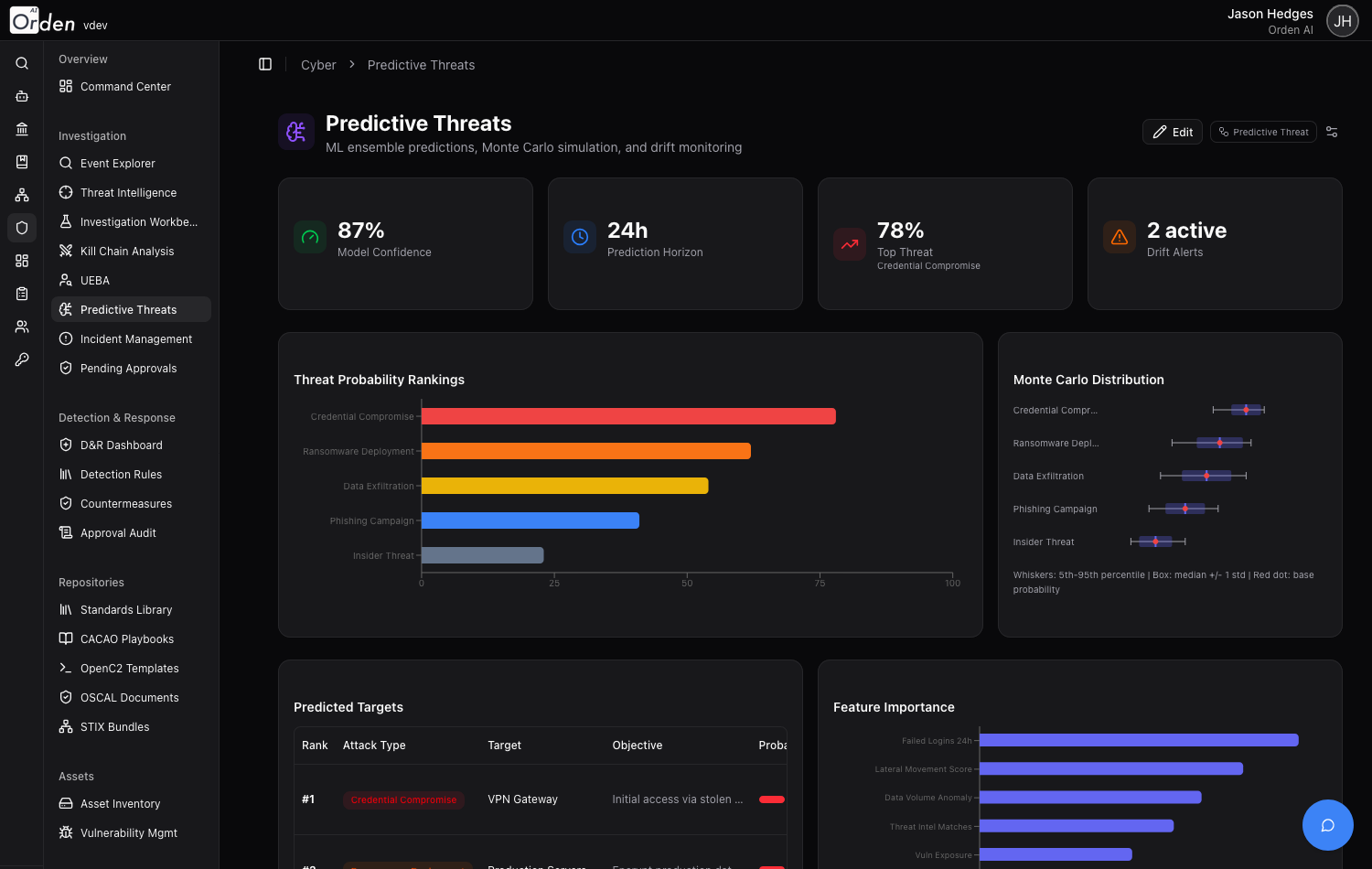
Orden Cyber predicts attack type, target, and objective before the attack executes, drawing on behavioral signals, UEBA data, and cross-domain telemetry. Confidence is expressed as Monte Carlo simulation intervals, not single-point estimates.
Behavioral indicators are projected forward into the likely attacker objective, not just the next observed step.
Probabilistic ranges, not binary alerts. Analysts see the distribution of likely outcomes, not just a single label.
UEBA, asset state, identity behavior, and OSINT all feed the same predictive layer.
Legacy SIEM platforms fire alerts after thresholds are crossed. Orden surfaces the threat before the attacker reaches their objective.
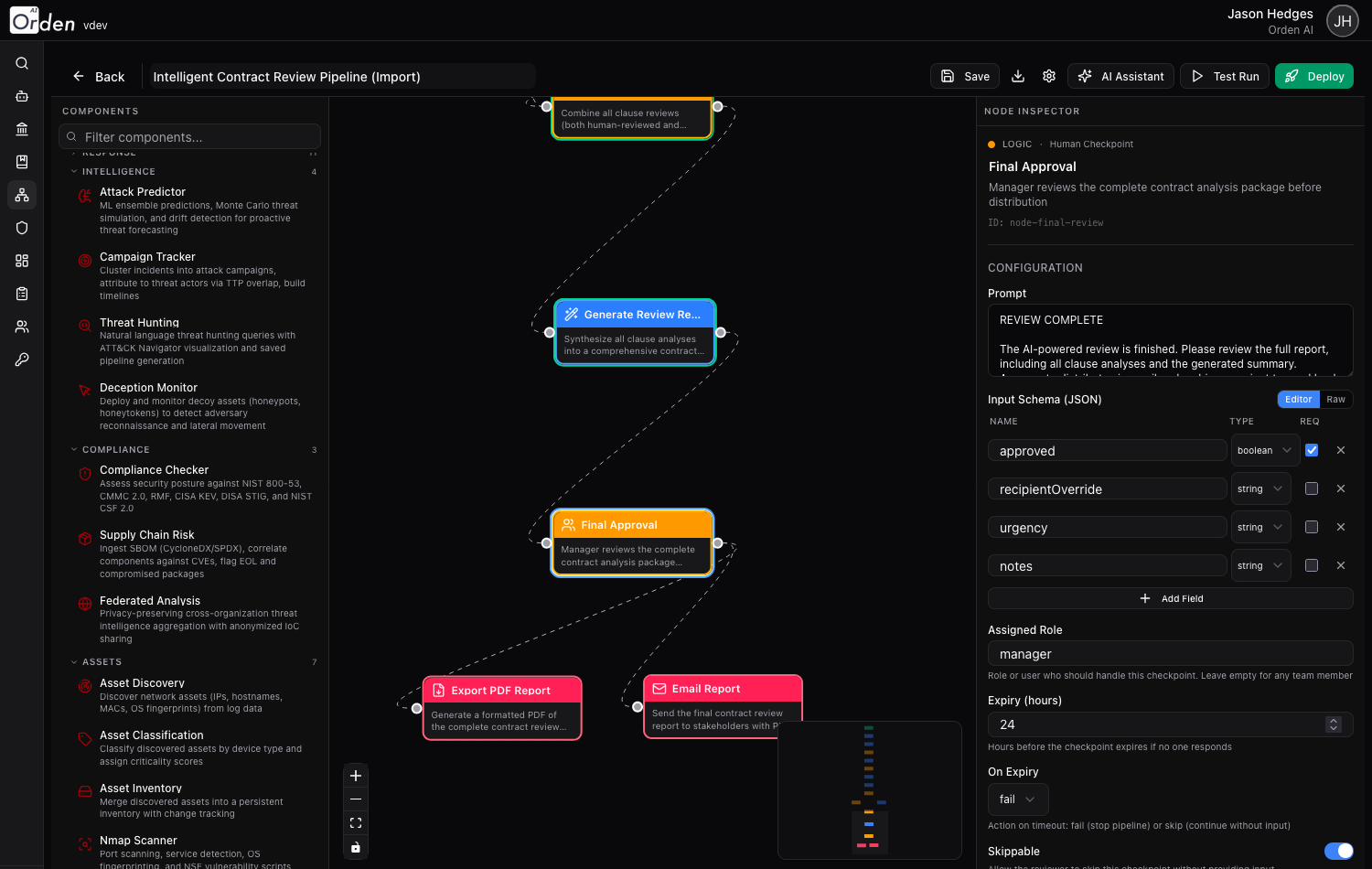
Approval checkpoints are pipeline nodes: role-based, with configurable expiry, evidence presentation, and plain-language feedback loops. The AI cannot take a network-level action without passing through a checkpoint if the pipeline requires one. Enforced by the pipeline architecture itself.
Role-based assignment, expiry timers, evidence presentation, and feedback loops are configured per checkpoint.
Auto-execute, queue-for-operator, or documentation-only, chosen per pipeline and per response action.
Approval is encoded in the pipeline graph, not in an admin setting. Compliance posture survives staff turnover.
Darktrace Antigena takes autonomous response actions by design. In a DAF enclave or any environment with strict rules of engagement, that is a liability, not a feature.
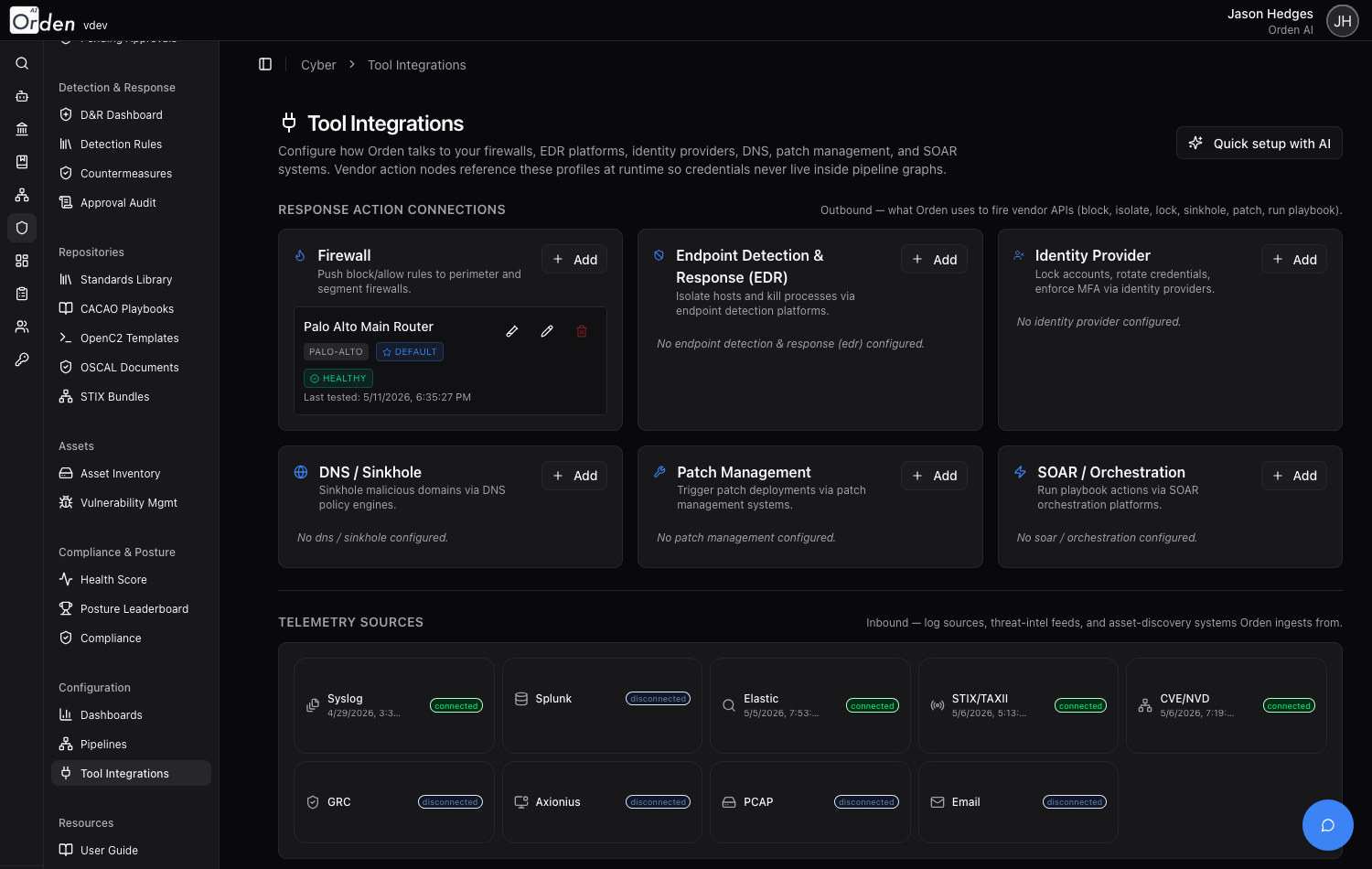
Every response action is expressed against a capability (firewall, EDR, IdP, DNS, patch, SOAR) rather than a vendor. Switching from CrowdStrike to SentinelOne or Palo Alto to Fortinet means reconfiguring one credential profile. Every pipeline, countermeasure, and approval workflow keeps working unchanged.
"Block IP" is a capability call; the firewall vendor is a credential profile underneath. Pipelines do not change when the vendor does.
AES-256-GCM with rotating master key. Per-environment credential profiles, swappable without touching pipeline logic.
Lab IPs are routed to the lab firewall, production to production, automatically selected by environment context.
SOAR competitors hard-code vendor SDK calls into playbooks. Vendor migration becomes a multi-month rewrite. Orden makes it a credential update.
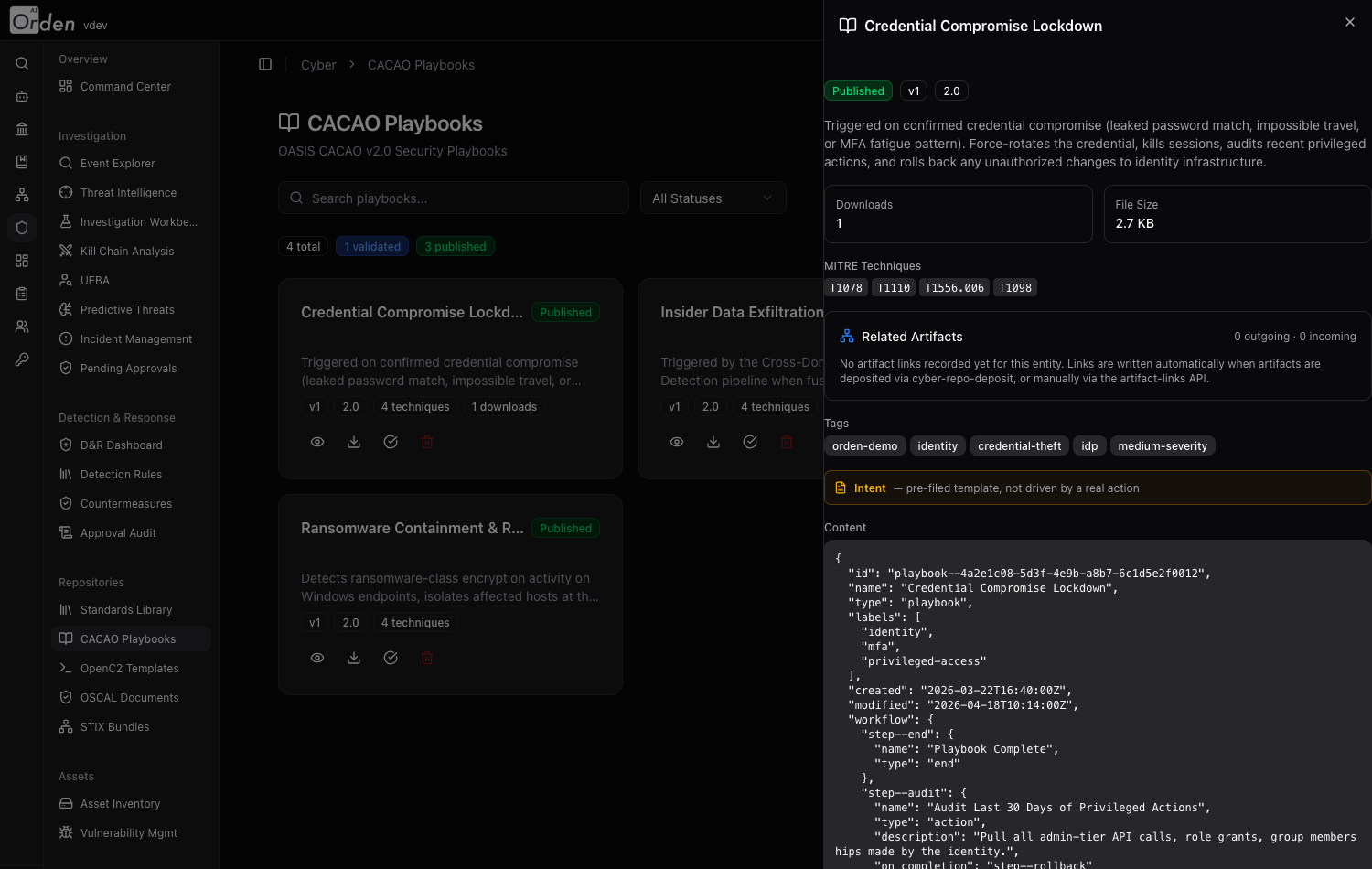
CACAO playbooks, OpenC2 commands, and OSCAL evidence describe what actually happened. They are generated after the vendor API fires, with execution timestamp and outcome embedded. Orden is also a CACAO 2.0 runtime, not just an emitter.
Walks and executes playbook workflow steps as part of any pipeline, not just emits a JSON document at approval time.
SLPF, ER, and standard OpenC2 profiles executed against live integrations, with audit-grade response records.
Artifacts describe what fired, when, and with what outcome, not just what was approved.
Competitors emit artifacts at approval time: intent only. FedRAMP, CMMC, and SOC 2 evaluators can tell the difference. Auditors need execution records, not approval records.
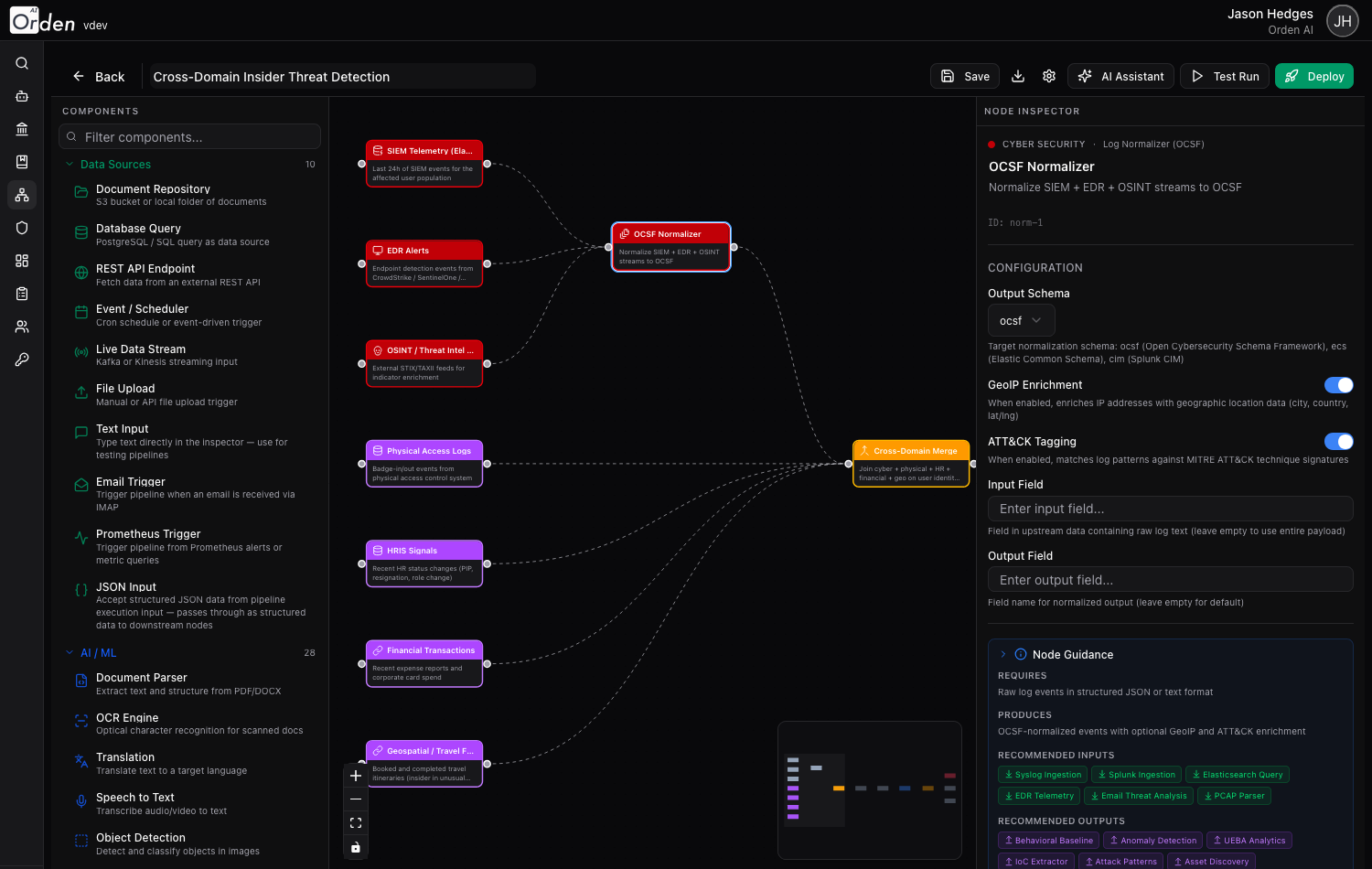
Physical access logs, HR systems, financial data, geospatial feeds, and OSINT are treated as first-class pipeline inputs alongside SIEM telemetry and EDR feeds. Correlation patterns that span cyber and non-cyber domains are simply not expressible in platforms built on a fixed data model.
Badge logs, HRIS records, financial transactions, and geospatial feeds, all joined to SIEM and EDR data within a single pipeline.
Syslog, CEF, LEEF, PCAP, NetFlow ingested and normalized to OCSF across every source.
The insider who badged into the server room before the exfiltration event becomes a detectable pattern.
Every competing SIEM defines a fixed data model. The correlations that matter most, such as the insider who badged into the server room before the exfiltration event, are invisible to them.
Built on Orden Core's agentic pipeline runtime, deployable from a laptop to an air-gapped enclave. See how Orden Cyber compounds with every analyst, incident, and decision.