Orden Agentic is durable, named agents that pursue goals, the workflows they follow, the tools they call, and a distributed runtime that governs all of it. Your existing processes become the agent's tools (databases, APIs, approval queues, ticketing), invoked like an operating system exposes system calls: permissioned, sandboxed, and logged on every use. Grant an agent exactly the workflows and tools it needs, set exactly how far it may go without asking, and it remembers what it learned and can never exceed the authority of the person who owns it, all inside your own boundary, on your own models.
Most platforms give you an "agent" that is really a prompt inside one workflow, which evaporates when the workflow ends and takes its context with it. An Orden agent is a first-class object with a charter, a toolset, a memory, an owner, and a run history you can browse, and it can never exceed the authority of the person who owns it.
A charter (goal, persona, system prompt), a toolset, an LLM configuration, budgets, a memory, an owner, and a lifecycle state. It exists between runs and accumulates a body of work you can inspect, correct, and redeploy in another environment.
One autonomy dial is the only control that can widen what an agent does unattended. Policy can only narrow it, and a hard floor on outbound and destructive actions never lifts, whatever the dial says.
Every workflow generates a living SOP and, on completion, a narrative debrief: documentation and provenance as byproducts of doing the work, so they always match what actually ran.
A charter, a toolset, a budget, a manager, and a clear limit on what it may do without asking. Your existing systems become that toolset: an operating system exposes system calls, and Orden exposes your databases, APIs, approval queues, and ticketing the same way: permissioned, sandboxed, and logged on every use.
Charter, toolset, LLM configuration, budgets, memory settings, owner, avatar, trust level, autonomy dial, and lifecycle state: active, paused, degraded, or quarantined.
When an agent needs permission, the request appears inline in the conversation showing the exact tool and arguments, because the person who asked is already watching.
Monthly spend, daily tokens, hourly rate, and concurrency limits, each shown against actual consumption, with a kill switch that stops every agent in the organization at once.
Lead, Contributor, Reviewer, Approver, Specialist, and Observer, composed from capability primitives and enforced at the tool-resolution layer, not rendered as labels in a UI.
A workflow isn't locked to one trigger. Author the logic once, and the runtime decides how it's reached: on a schedule, on an event, on a chat message, on an API call, or because an agent decided the moment had come. When an agent waits on a tool, a human, or a timeout, its state serializes and the worker is freed. Long-running work costs nothing while it waits, and survives a restart.
Cron with timezone support, inbound events, a chat message, a REST call, or another agent's decision: the same logic, reached however your organization actually works.
Waiting on a tool, a human, or a timeout doesn't hold a worker hostage. State serializes to the database and resumes exactly where it left off, including after a restart.
Agents subscribe to the event streams your systems already produce. They wake because something happened, do their work, and stop. No always-on loop burns tokens waiting for change.
The runtime resolves each activation's real context window and assembles the prompt in budgeted sections with guaranteed floors: the charter and semantic core are never sacrificed. If it can't fit, the run fails clearly instead of silently truncating instructions.
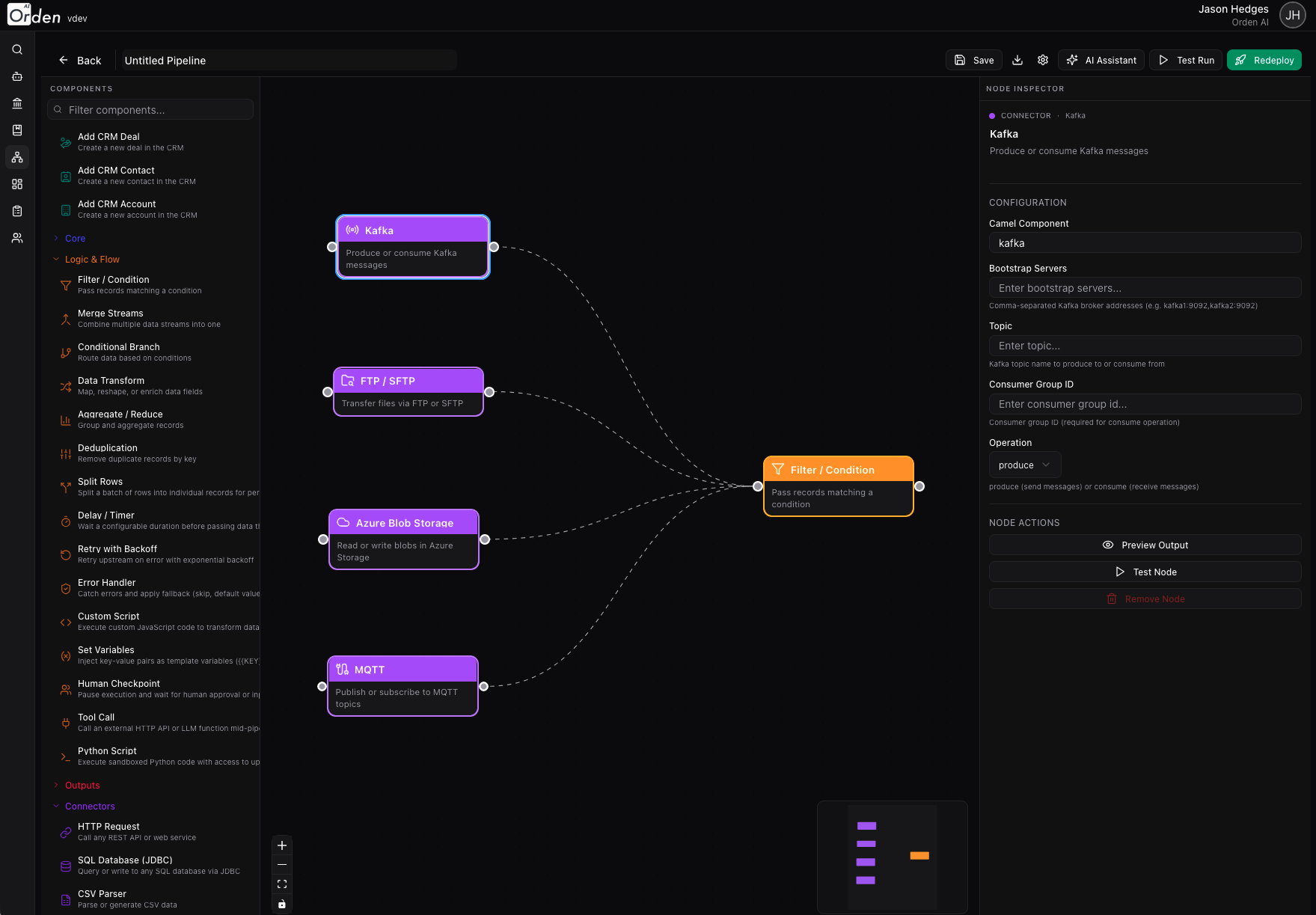
Drag and drop your way from idea to production. Orden's visual workflow editor lets you chain AI models, data sources, logic gates, and enterprise connectors into deterministic execution graphs that pattern how the process actually runs. No code required.
Build agentic workflows on a canvas. Drag nodes from a categorized palette, connect them visually, configure parameters in a side inspector.
Source, AI, Logic, Output, Connector, Finance, Cyber, GIS, and more. 330+ operation nodes covering everything from LLM calls to Monte Carlo simulations.
Save, version, and deploy workflows to production. Schedule executions, share with team members, or fork system templates to get started fast.
Pre-built workflow templates for common processes. Fork and customize: from data enrichment to document analysis to financial modeling.
Visual workflow editor with categorized node palette and inspector
An agentic workflow is a visual graph you draw once: the same steps, in the same order, following the same branching logic, every time it runs. That is what makes it a pattern of a real process rather than an improvised chain of prompts; the graph is deterministic even where an individual node calls an LLM for judgment, extraction, or generation.
Branching, retries, approval gates, and error handling are explicit nodes on the canvas, not buried in a prompt. What runs is exactly what you can see and audit.
LLM and ML nodes sit inside the deterministic structure exactly where a decision genuinely needs intelligence; everything around them executes the same way every run.
Same input, same path, every time. Every run is scored and priced per node, so a workflow behaves like the documented procedure it represents, not a black box you hope produced the right answer.
The same graph runs the same way every time. AI nodes make judgment calls exactly where you place them; the rest of the process is fixed, explicit, and auditable.
Most platforms can only reason inductively: ask an LLM and hope the pattern holds. Orden runs genuine theory-driven models as workflow steps, and gives you a guided path to train your own when a pre-built model isn't the right fit.
Author causal DAGs visually and estimate real effects with established causal-inference methods, so a workflow can answer "what caused this" instead of just "what's correlated with this."
Model feedback loops and stocks-and-flows visually, then simulate how a system evolves over time, built for the long-horizon, interacting-variable questions an LLM can't reliably reason through.
Guided workflows for anomaly detection, time-series forecasting, and other model families drop a pre-wired training pipeline into the editor and write the result to your own storage; retraining becomes a scheduled run, not a data-science project.
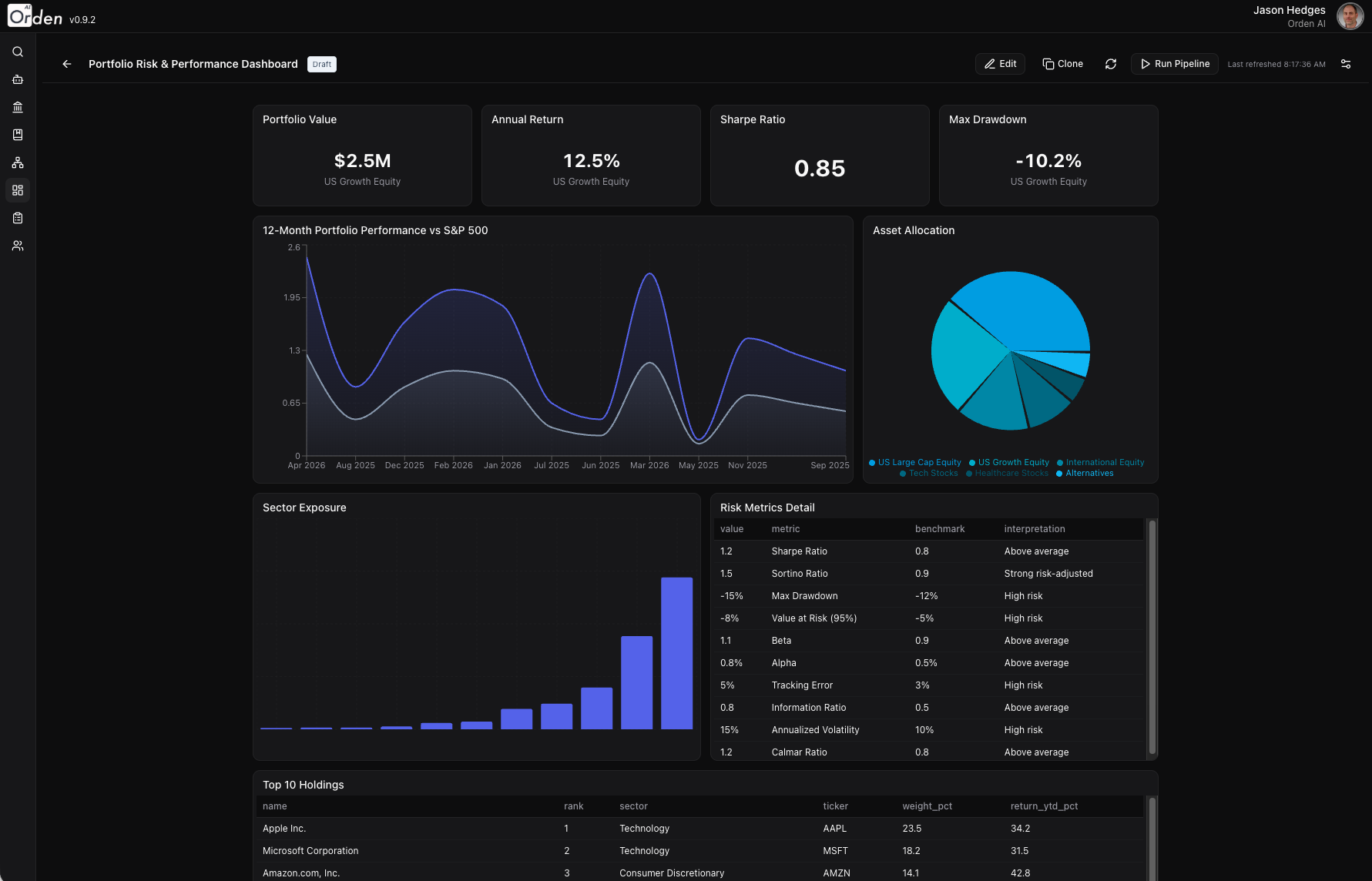
Run a workflow, then ask AI to build a dashboard from the results. A rich library of out-of-the-box widgets, drag-and-drop grid layout, and smart field mapping, all generated automatically from your data.
Stat cards, bar/line/area/pie/scatter/radar charts, tables, KPIs, markdown text, geo maps, progress bars, list feeds, with a framework for building custom widgets.
Complete dashboards created from natural language. AI introspects workflow output fields and builds data-aware widget configurations.
Resize and rearrange widgets freely on a responsive grid. Pin dashboards from AI chat, export/import configurations, and share with your team.
Save standalone widgets to a shared library. Materialize into dashboards or embed directly in AI chat. Duplicate, share, and reuse across projects.
AI-generated dashboard with drag-and-drop widget layout
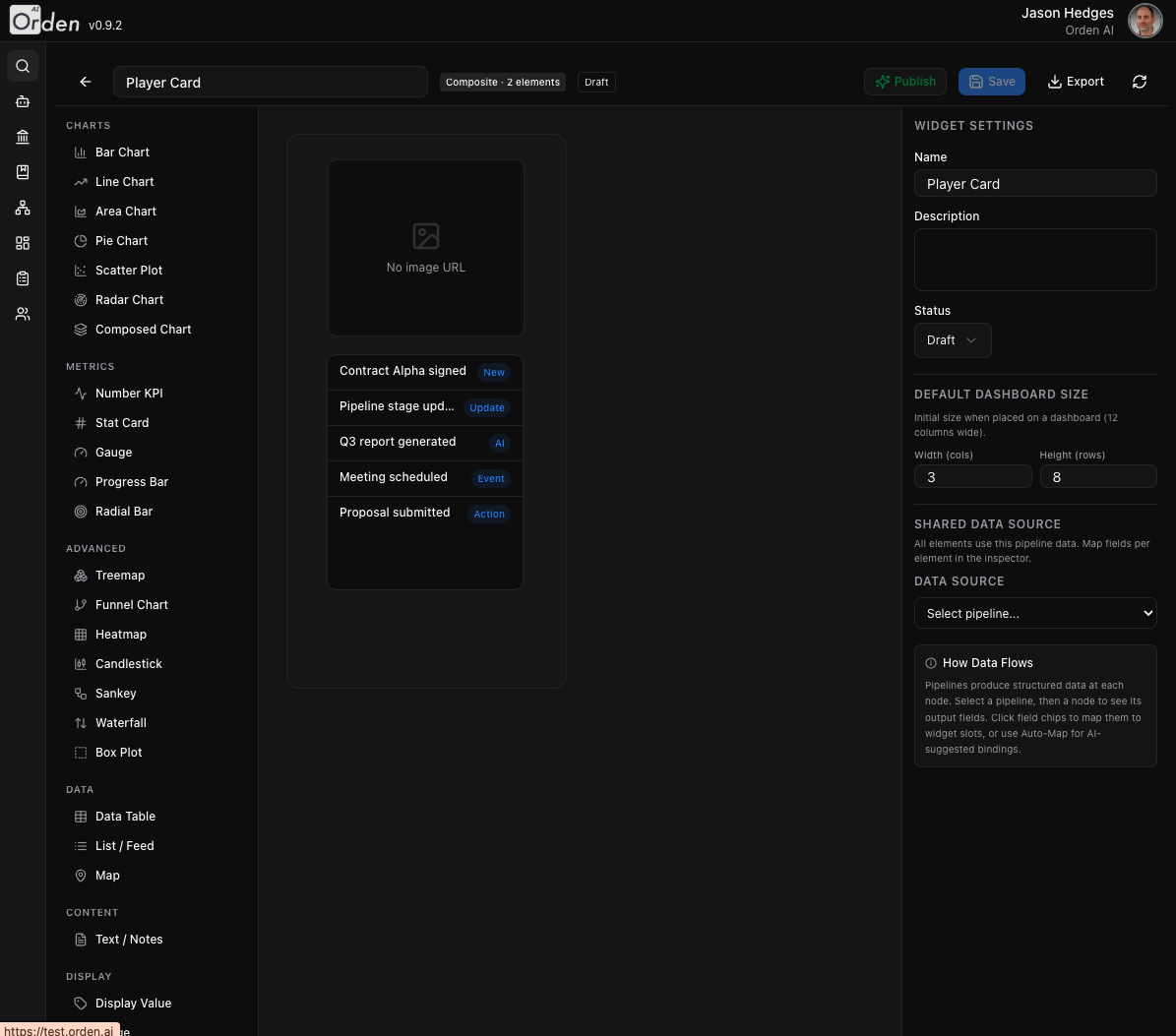
Widget library with live preview editor
Create standalone widgets with a dedicated editor and live preview. Save them to a shared library, then materialize into any dashboard or surface them directly in AI chat conversations alongside your LLM interactions.
Configure widget type, data source, and styling with instant visual feedback. See exactly how your widget will look before saving.
Share widgets with team members. Duplicate and customize existing widgets to create variants without starting from scratch.
Pull widgets from the library into any dashboard via the "From Library" tab. Widgets maintain a reference link for synchronized updates.
Orchestrate LLMs (Claude, GPT, Llama, Mistral), vision models, speech-to-text, embeddings, classification models, or your own fine-tuned AI/ML models, all from a single platform. Then build agentic workflows that connect model outputs to your real organizational processes.
Swap models without changing code. Run LLMs alongside computer vision, NLP, and custom ML models in the same workflow. Add new models as they are released. No platform changes required.
AI models alone don't solve business problems: agentic workflows do. Connect model outputs to databases, APIs, notifications, approval workflows, and enterprise systems. Turn AI capabilities into operational processes.
AI assistant that understands your documents, team docs, workflow results, and organizational context. Get answers with source citations. Route queries to the best model automatically.
330+ operation nodes and enterprise connectors out of the box, with an extensible framework for building custom agents. Pull data in, push results out, automate across your entire stack.
Extensible connector framework. Build custom agents and integrations through Enterprise Enablement.
Extending an agent's reach or moving it to a new environment shouldn't mean losing control of it. Every extension point is allowlisted, every export is deliberate, and everything an agent knows stays correctable.
Remote MCP servers are an administrator-allowlisted capability with pinned tool schemas. If a server's advertised tools change, that requires re-approval instead of silently expanding what your agents can do.
Export an agent as a versioned bundle in the profile you choose: definition only by default, or with explicitly flagged starter knowledge. Credentials and connections never travel, and imported knowledge can be revoked in bulk.
Everything an agent has learned is browsable, with the run and evidence that produced it. An agent that learned something wrong is a quick correction, not an unexplained behavior change to debug.
An agent's permissions are checked against its owner's access continuously, not just at setup. If an owner's access changes, the agent is flagged rather than left quietly over- or under-privileged.
Every workflow execution produces structured data. Describe the dashboard you need in plain English, and AI builds it: selecting widget types, mapping fields, and laying out the grid automatically.
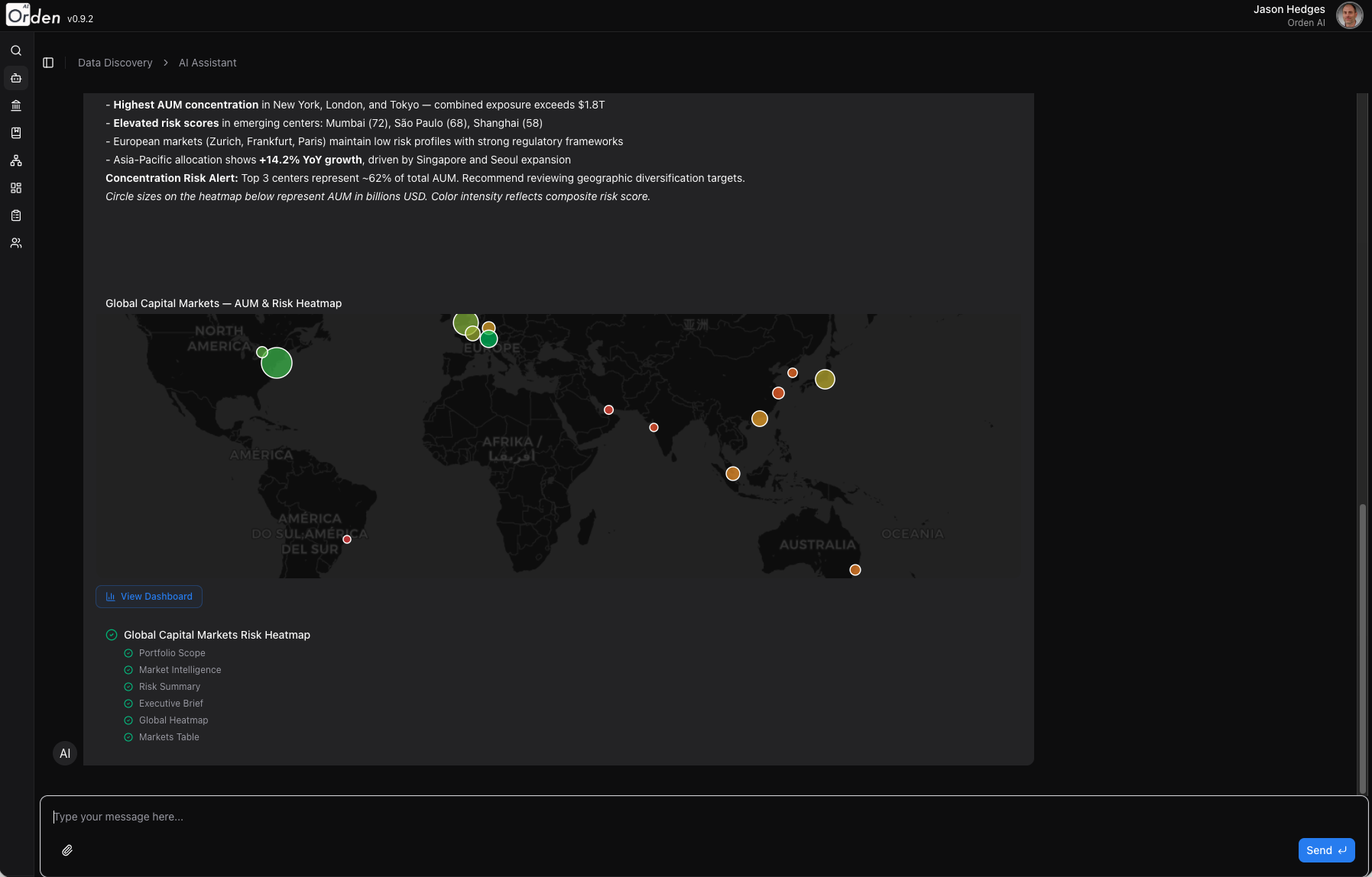
A rich library of out-of-the-box widgets (from stat cards to geo maps) plus a widget builder for custom visualizations. Dashboards integrate directly into AI chat, so your agentic workflows can surface insights in real time. Export, share, and pin dashboards with one click.
Explore Dashboards →
Beyond agents, workflows, and dashboards, Orden Agentic includes a full suite of enterprise AI tools.
Enterprise knowledge base with spaces, pages, rich text editing, and AI-powered completion. Content auto-embedded into vector search for organization-wide discovery.
Accounts, contacts, deals, and activities with visual pipeline stages. Purpose-built for tracking relationships and deal flow within your AI platform.
Semantic search across your entire document corpus. Natural language queries, role-based access on every record, and instant answers with source citations.
Automatically process 100+ file types including PDFs, Office docs, images, video, and audio. Intelligent OCR, entity extraction, and metadata enrichment.
OAuth2/OIDC, LDAP/AD federation, MFA, end-to-end encryption, audit logging, brute force detection. Architecture aligned with FedRAMP, NIST 800-171, HIPAA, and SOC 2 control objectives.
Rich text document editor with AI-powered writing assistance, auto-completion, and intelligent content suggestions. Create, review, and refine documents with AI as your co-author.
Complete audit trail for every action across the platform. Track who did what, when, and where, across AI queries, workflow executions, document access, and administrative changes. Built for compliance reporting.
Retrieval-augmented generation built into the platform. Ingest documents, chunk and embed automatically, and ground AI responses in your organization's actual data, with source citations and access controls on every retrieval.
Run virtually any AI or ML model: LLMs, vision, speech, embeddings, classification, or your own fine-tuned models. Model registry, version management, automatic routing, and intelligent fallback across providers.
Agentic AI in every tier. Priced by reach, not usage.
Up to 20 users
$2,250 / seat
Up to 90 users
$1,000 / seat
Up to 300 users
$583 / seat
300 to unlimited
Custom / per enclave