Operational Knowledge Layer

The workflow is the documentation.
It can never drift.

As your automated agentic workflows run, Orden Fabric turns everything they do into living, governed, queryable institutional memory: what happened on every run, how each process works, the entities and relationships involved, and every human decision taken. All of it is searchable in plain language, traceable back to the exact run that produced it, and runs entirely inside your own environment on your own models.

Self-Writing
SOPs, regenerated on every publish
Cited
Every answer traces to its source run
Sovereign
Runs entirely inside your boundary
Why Orden Fabric

Institutional memory that compounds instead of decays

Your operational knowledge stops living in individual heads and stale wikis and becomes an asset that compounds every time work runs. Even if you switched off the AI tomorrow, the debriefs and runbooks it produced are plain, human-readable prose that survive on their own. That is the perpetual value: the institutional memory outlasts any model.

The Knowledge Base Fills Itself

Fabric populates from real runs: it synthesizes a narrative debrief, extracts entities and relationships, records decisions taken, and indexes it for retrieval, with no human writing anything.

  • Competing platforms ship empty and stay empty
  • Fabric grows on its own and gets richer with use
  • No analyst effort required to keep it current
  • Every workflow run is a contribution, not a chore

Perpetual Value, Even AI-Off

Every debrief and SOP is human-readable prose, not a model artifact locked behind an inference call. A durable institutional asset, not a rented access point.

  • Turn the AI off, disconnect it, or replace it
  • Runbooks and operational memory remain fully usable
  • You are building an asset you own, not renting access
  • Documentation and provenance are byproducts of the work

Governance Is Architectural

Human approval checkpoints are workflow nodes, not a setting an admin can quietly disable. Every consequential decision produces an exportable, one-page audit record.

  • Trigger, context, AI recommendation, and cited policy
  • The human decision, who and when, or auto-approved
  • Outcome and full lineage, ready for an auditor
  • Role-based access enforced on every surface
Ask the Fabric

Plain-language answers, grounded and cited

Ask a question and the answer is grounded in your own debriefs and process documentation, with inline source citations you can expand. When there is no grounding for a question, the Fabric says so instead of inventing an answer.

Grounded Q&A

Answers are built from your run debriefs and SOPs, not a generic model's training data, with citations you can expand to the source.

Run It From the Answer

When an answer is about a workflow, a Run action launches it directly: fill its form and kick it off without leaving the knowledge view.

Grounded in Your Vocabulary

A per-organization glossary and ontology primes retrieval so the Fabric reasons in your terms, not a generic model's.

Honest About Gaps

When there is no grounding for a question, the Fabric says so instead of inventing an answer. Governed, cited, and honest by default.
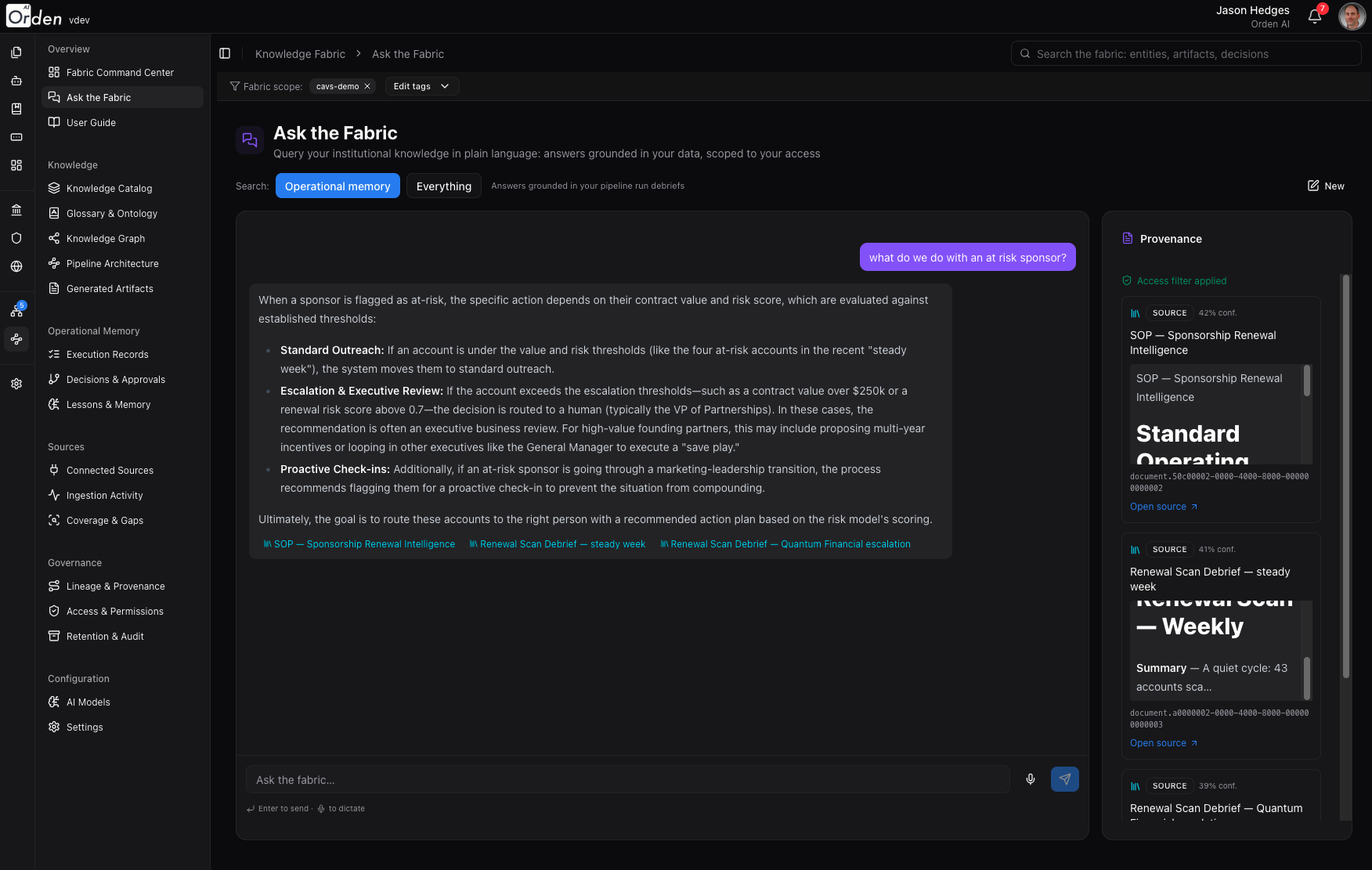
Ask the Fabric: a grounded answer with a confidence-scored source panel and open-source links

Every answer cited, with confidence scores and a direct link back to the source document
Workflow Architecture & Auto-Generated SOPs

A living runbook for every workflow, always current

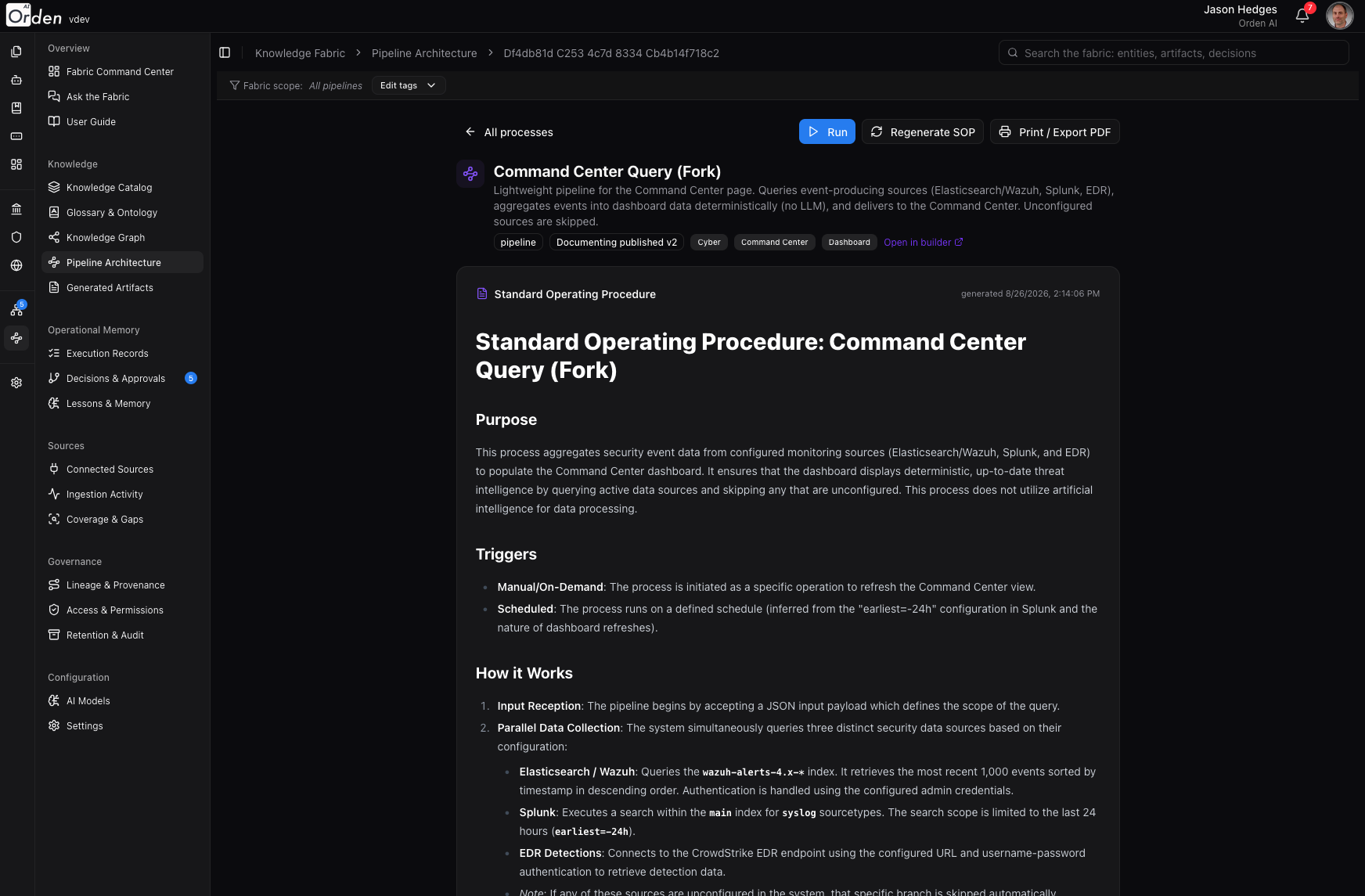
Every workflow has a step-by-step standard operating procedure that is generated automatically and regenerated whenever the process is published. The runbook is a byproduct of the work, so it always matches what actually runs.

Purpose, Steps, Accountability

Purpose, step-by-step flow, decision points with named accountability, and a version changelog, generated with no human writing anything.

Regenerated on Publish

Every other documentation tool goes stale the instant someone edits the workflow. This one regenerates itself, so the gap where audits and onboarding fail simply doesn't exist.

Printable, Exportable, Runnable

Exportable to PDF, printable for a binder, and runnable in one click straight from the documentation itself.

Auto-generated Standard Operating Procedure with Purpose, Triggers, and How It Works sections
Knowledge Graph & Lineage

Trace any answer all the way back to the run

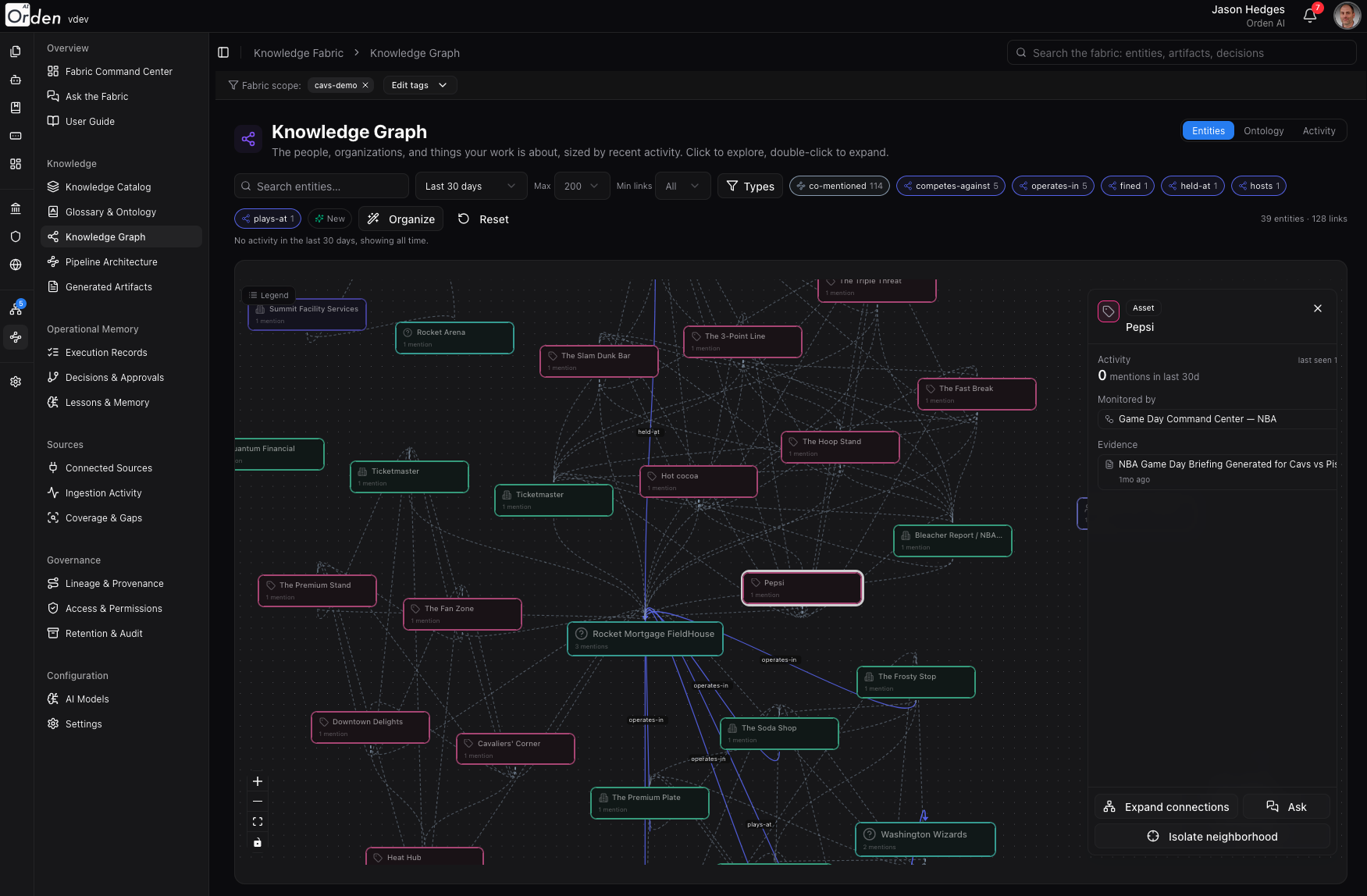
The entity and provenance graph self-populates from real runs. The Lineage view walks any answer back through debrief to execution to workflow, along with every entity, decision, and the human who triggered it.

Self-Populating Knowledge Graph

Relationships such as mentions, monitors, is-a, ran, and derived-from, enriched by your organization's own ontology.

Full Lineage, Not a Guess

The run that generated an answer, the workflow behind it, the entities it mentions, who triggered it and how, and the decision made, linked to its audit record.

Provenance You Can Defend

This is the record that FedRAMP, CMMC, SOC 2, and internal audit actually want: provenance you can defend, not a confident guess.

Knowledge Graph: entities sized by activity, with evidence and monitoring shown on selection
Decisions, Coverage & Governance

An audit trail you can hand to an auditor

Human-in-the-loop checkpoints, an exportable decision packet for every consequential call, and honest coverage reporting so you always know what the AI can and cannot answer.

Decisions & Approvals

A one-page decision audit packet: trigger and context, AI recommendation with confidence and cited policy, the human decision or a policy-based auto-approval, outcome, and lineage.

Coverage & Gaps

Coverage measured against what is genuinely retrievable, not a "we attempted to index this" flag, plus freshness of the knowledge and a complete inventory of the real gaps.

Generated Artifacts

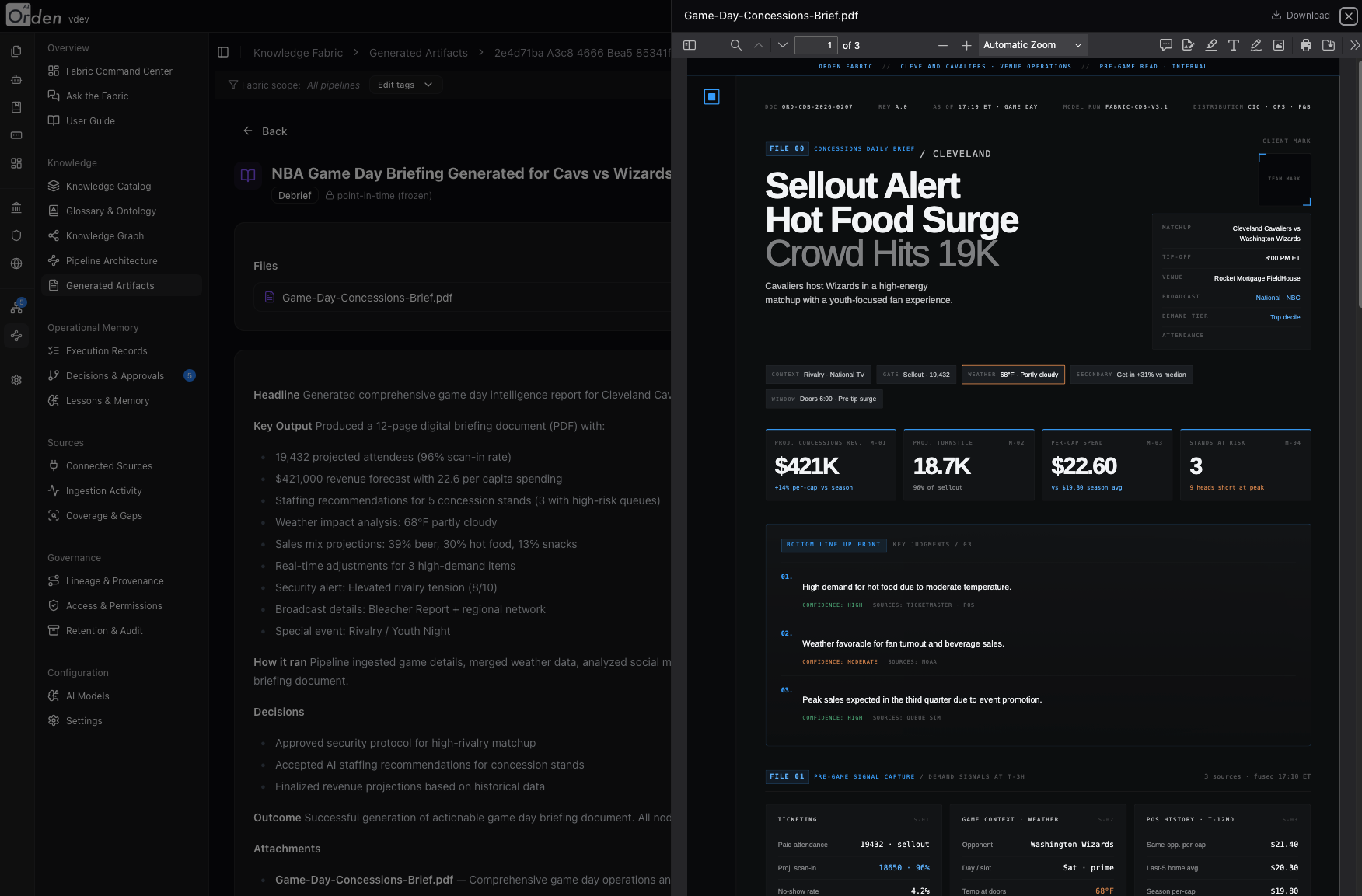
Every debrief, SOP, dashboard digest, and semantic profile the workflows produce, all searchable, sortable, and filterable, with inline PDF preview.

Execution Records

Full, filterable run history that feeds the Fabric, scoped to the domains and tags a given team cares about.

A generated debrief with headline, decisions, and outcome, and its PDF artifact open for inline preview

A run's debrief, with its generated PDF report open for inline preview

More Capabilities

The infrastructure behind the knowledge

Configuration, connections, and vocabulary that keep the Fabric grounded in how your organization actually works.

Fabric Settings

Organization-wide defaults (auto-generate a debrief on run completion, inject your glossary into retrieval), default knowledge scope by tag, and per-scope LLM configuration.

Glossary & Ontology

Your organization's vocabulary plus its entity and relationship types, giving the knowledge graph a schema that matches how your business actually thinks.

Fabric Connections

Governed, encrypted connections to your data sources, with setup validation and credentials that never appear in graphs, logs, or API responses.

Scoped by Tag

Search, graph, coverage, and lineage all filter to a single tag, so one deployment presents many focused views: per client, per program, per classification domain.

Automatic Entity Extraction

On completion, a run synthesizes a narrative debrief and extracts the entities and relationships it involved, with no analyst effort.

Sovereign Deployment

Runs entirely inside your environment: on-premise, private cloud, or air-gapped. Inference runs on an endpoint you control, per organization and per knowledge scope.

Glossary and Ontology editor, with terms and relationships suggested from pipeline runs

The ontology suggests new terms it's seen in your pipeline outputs. Approve or reject with one click

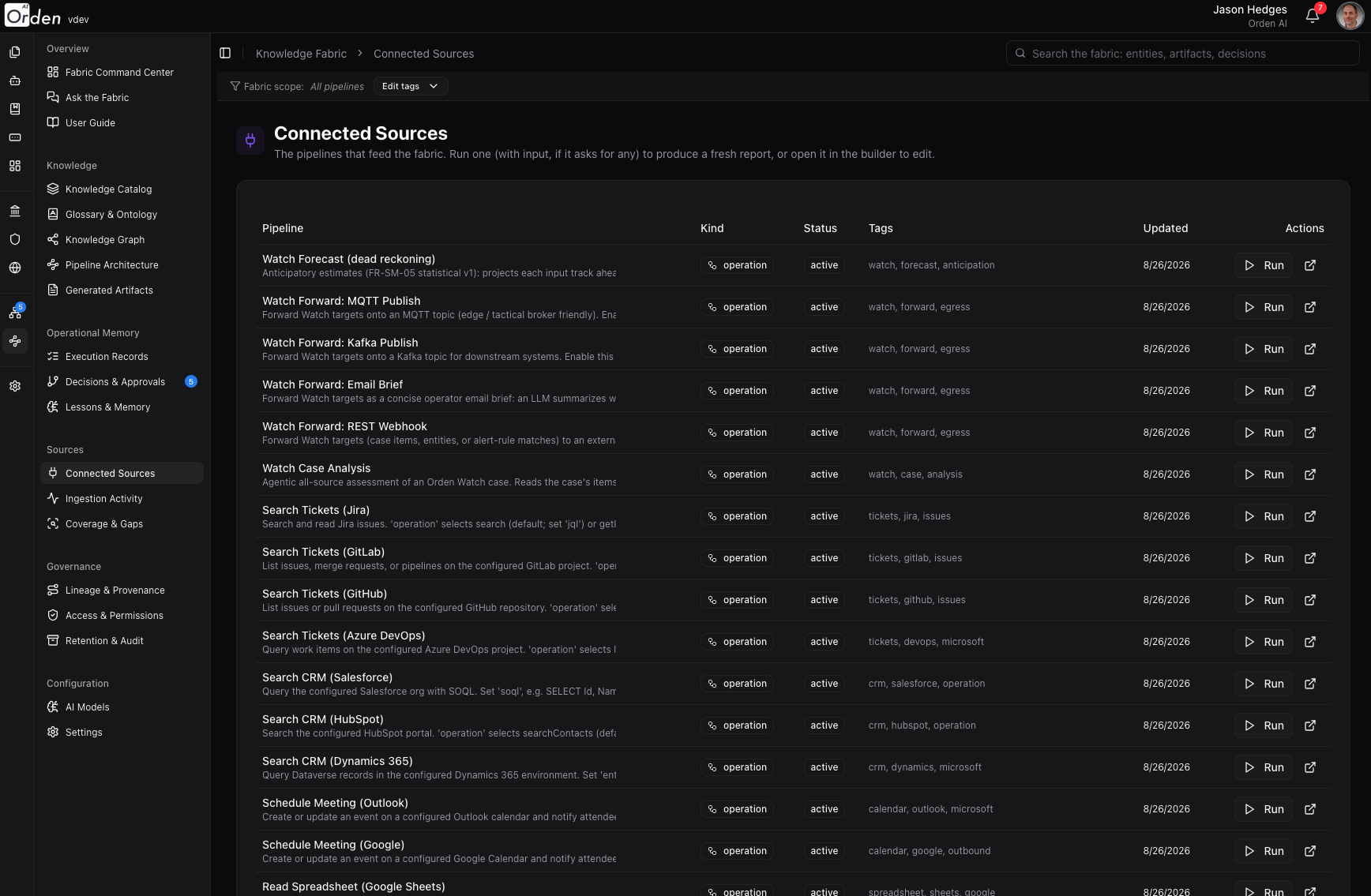
Connected Sources: the pipelines feeding the fabric, from Jira and GitHub to Salesforce and HubSpot

Every connected source is a real, runnable pipeline: Jira, GitHub, Salesforce, HubSpot, and more

Architecture

Built on Orden Agentic

Orden Fabric is fed by the same runtime that runs your agentic workflows. Documentation, provenance, entity extraction, and memory are first-class outputs of doing the work, not a separate integration project you staff and maintain.

Debriefs

  • Synthesized automatically on run completion
  • Narrative prose, not a raw log dump
  • Entities and relationships extracted alongside

Checkpoints

  • Human approval as a first-class workflow node
  • Cannot be quietly disabled by an admin
  • Every decision produces an audit packet

Retrieval

  • Access control enforced at query time
  • Your glossary and ontology prime the model
  • Cited answers, or an honest "no grounding"

Deployment

  • On-premise, private cloud, or air-gapped
  • Per-organization, per-scope LLM configuration
  • No separate documentation system to maintain
[ Get started ]

Ready to see Orden in action?

Schedule a personalized demo with our team and we'll show you exactly how Orden fits your use case.

Request a demo Contact sales